
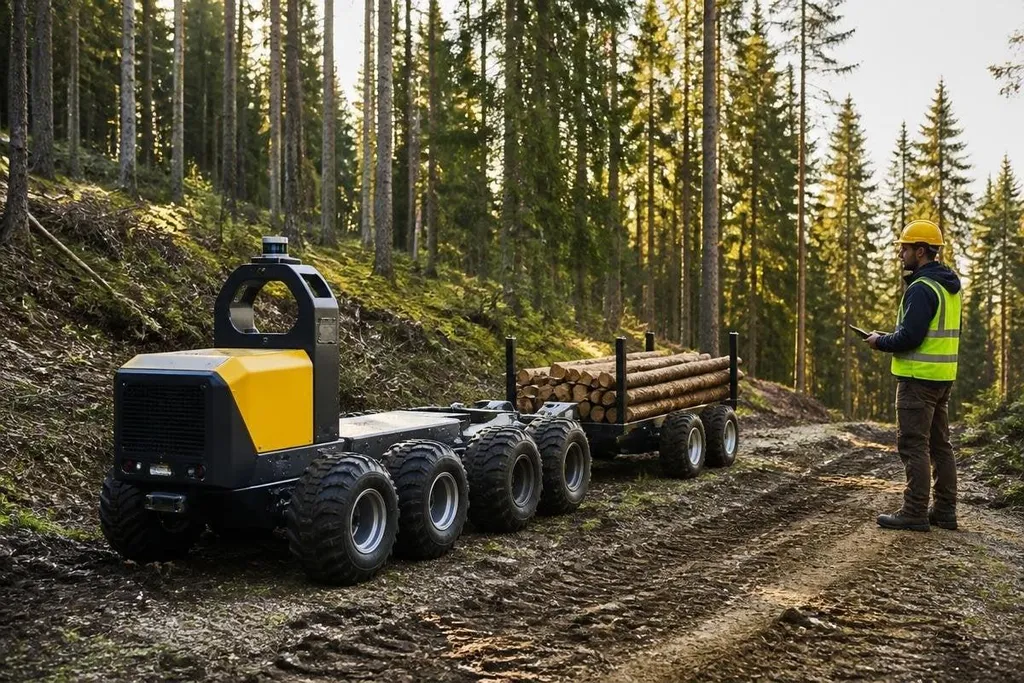
A forest gives robots problems that a factory floor removes: loose soil, steep ground, trees that block signals, and weather that changes the route. The first useful forestry robots will likely handle repeatable work near people, while humans keep control of cutting, planning, and safety decisions.
- Mapping machines can build updated routes through dense woodland.
- Hauling robots can move tools, plants, or cut material over short routes.
- Full autonomy remains unproven on steep, changing ground.
The forest is a hard worksite
A robot in a forest needs to locate itself while its surroundings keep changing. Tree trunks can block satellite signals, branches can hide landmarks, and mud can change how wheels or legs grip the ground.
That makes sensing as important as movement. Cameras can identify visible objects, LiDAR measures distance with laser pulses, and simultaneous localization and mapping (SLAM) helps a robot build a map while it moves.
The system still needs a safe response when leaves, rain, dust, or darkness reduce what its sensors can see.
Forestry work also spreads over large areas. The route may run between a road and a planting site, with stops for a human worker before the robot returns with a load. A machine that works well for ten minutes but needs frequent recovery has little use in that setting.
Where robots fit first
Mapping is a sensible starting point because the task can produce useful data without asking a robot to make many physical decisions. A machine can record paths, slopes, tree locations, or areas that need inspection, while a person checks the map before work begins.
Small hauling robots have a clearer job. They can carry equipment, seedlings, water, or cut material along a known route, reducing the distance a worker needs to walk with a load. The route still needs checks for fallen branches, soft soil, steep sections, and people entering the work area.
Inspection is another practical use. A robot with cameras can look for damaged trees, blocked access paths, or signs of pests. The useful output is a marked location and a clear image, not a claim that the machine understands the entire forest.
That distinction matters in forestry: one missed hazard can put a crew and its vehicle at risk, then delay the day’s work. When a lab trial moves toward forest work, Robot24.com forestry robotics coverage can connect the robot’s task to its test site and the human role before autonomy enters the discussion.
Autonomy will arrive in steps
A forestry robot doesn't need full independence to help. Remote control can handle difficult sections, while onboard software manages steady travel between known points. This shared control lowers the number of decisions the robot must make alone.
The next step is supervised autonomy. The robot follows a mapped route, slows near people, and stops when its sensors detect an object it cannot classify. A worker then reviews the alert and chooses whether to continue, turn back, or take control.
Power and recovery will shape the design too. Forest routes may be far from charging points, and a stuck robot can cost more time than it saves.
Makers will need to show how workers move the machine, change its battery, clean its sensors, and restart it after a fault.
The open question is not whether a robot can move through trees in a demo. It is whether the system can repeat the work across wet soil, rough ground, poor signals, and changing routes without constant rescue.
What to check before buying
A forestry team comparing a robot should ask:
- Route limits: Which slopes, ground types, and obstacles has the maker tested?
- Human control: Can a worker take over quickly when the route changes?
- Sensor gaps: What happens in rain, darkness, dust, or blocked satellite coverage?
- Load handling: How much can it carry, and how does the load affect travel?
- Recovery plan: Can two workers move it without special equipment?
- Proof from work: Has it completed repeated forestry tasks, or only short demonstrations?
I'd put mapping and short-distance hauling ahead of tree cutting for the first useful deployments. Those jobs have clear limits, measurable outputs, and a human can review the result before the next pass.
Forestry robots will earn wider use when makers publish route conditions, failure rates, recovery steps, and the cost of keeping each machine working. Until then, the best sign of progress is a robot that finishes a repeatable task and tells its operator when the forest has become too hard to handle.